
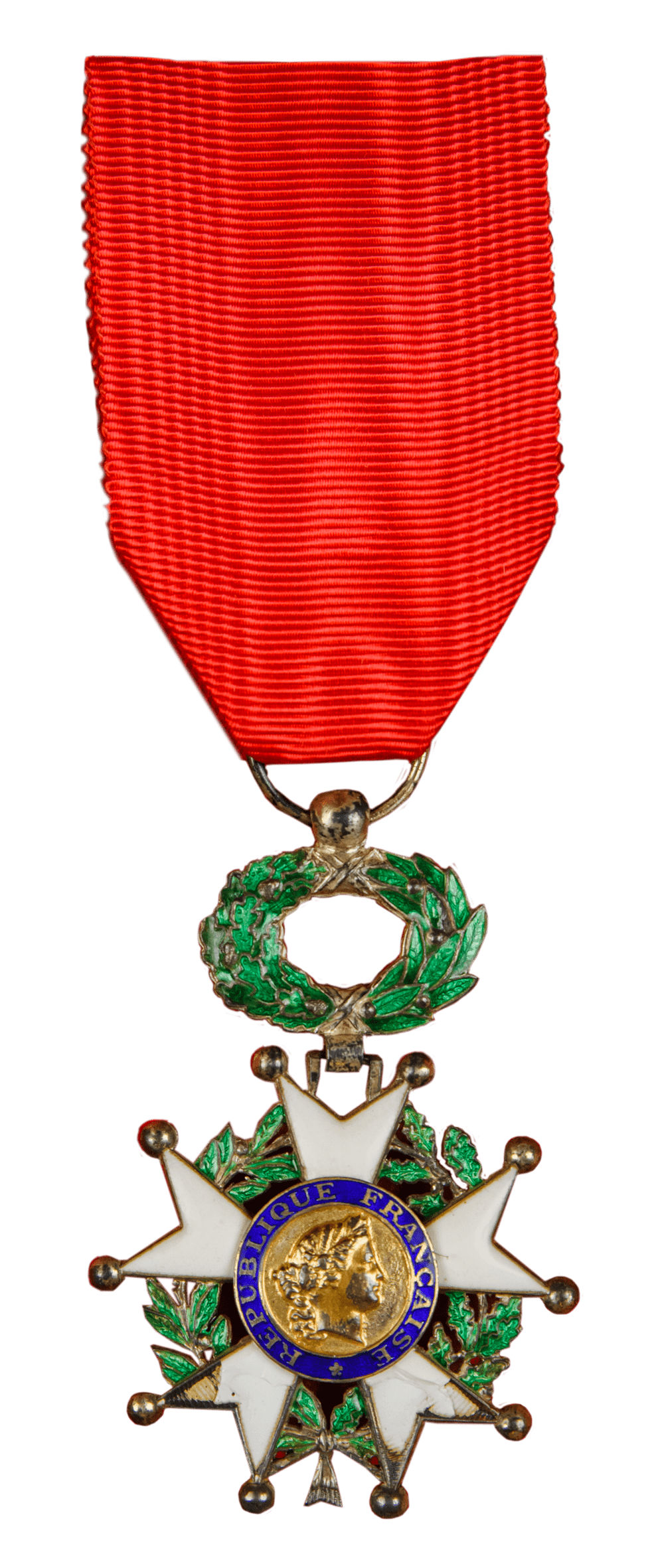
The Order of the Legion is the highest French award and one of the most well-known awards in the world. It recognizes exceptional military and civil merits of the most deserving persons who paid important services to the Republic. It was established on May 19, 1802 by the First Consul of France Napoleon Bonaparte. The insignia is a white enamel five-beam star with forked rays (forming the cross) and silver or golden spheres on the tips.
The Legion of Honor, badge of the cavalier
 France ,
23.06.1984
МЗСБ КП 21864
60 x120x 40 х 6 mm
metal, enamel, moire, stamping, weaving, assembly
The Legion of Honor, badge of the cavalier (l'Ordre national de la Légion d'honneur, grade du chevalier). Award to the city of Volgograd. Presented by Francois Mitterrand, the President of France 23.06.1984
See also


Small sculpture “The Symbol of Peace” on a pedestal and a stand
 Egypt ,
1958
Small sculpture “The Symbol of Peace” on a pedestal and a stand
A gift from the City Council of Port Said to the City Council of Stalingrad, 1958
United Arab Republic, Egypt, Port Said. It was given to the delegation of Stalingrad during their stay in Egypt; The inscription around the pedestal reads: “A symbol of Peace. To the Council of Stalingrad from the city Council of Port-Said”.

A banknote of 10 drachmas dating back to 1955 issued with a dedicatory inscription: “Let a piece of Greece devoted to Stalingrad stay in this dear city.”
 Greece ,
12.12.1958
A banknote of 10 drachmas dating back to 1955 issued with a dedicatory inscription: “Let a piece of Greece devoted to Stalingrad stay in this dear city.”
A gift from K. Pomonas, a Greek tourist. Byzantine temple; on the back there is a portrait of the King George II of Greece (1890-1947), the first constitutional monarch of Greece. On the right there is a pen-written message that reads: “May a piece of a true-hearted Greece stay in the dearest Stalingrad / K. Pomonas”